关于庞加莱猜想的一些记录
下面都是当年关于庞加莱猜想争论的一些记录。在网络档案有存档。
1,汉密尔顿谴责《纽约客》的谎言,并说,没有丘成桐就没有庞加莱猜想的破解,因为丘第一个认定瑞奇流方法可以破解此猜想。
众所周知,佩雷尔曼本人拒绝领取克雷所的百万大奖,理由说得明明白白:“不公平,汉密尔顿的贡献不比我少”——克雷所颜面无存,颁奖却被获奖人称为“不公平”而不敢拿。
汉密尔顿曾驳斥所谓“丘成桐为学生抢功”的谎言,指出丘先生“除了认为我和佩雷尔曼应该分享破解庞加莱猜想荣誉,没有说其他人(nor that Perelman should share credit for the Poincare conjecture with anyone but me)”。所以,佩雷尔曼在此问题上站在丘成桐一边,指责克雷所。
https://asymptotia.com/2006/09/27/hamiltonian-support/

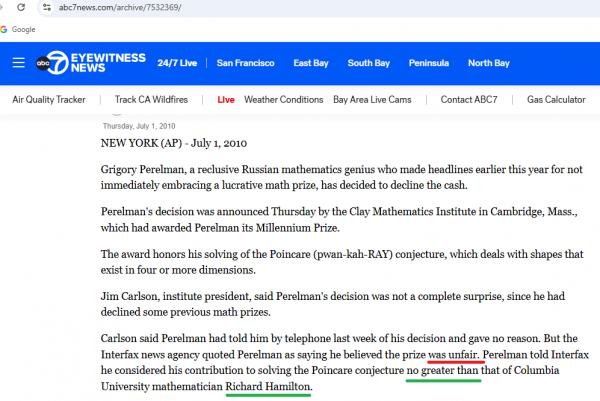
3. NPR(美国国家公立电台)记者检查了在北京会议上的整段录音,没有发现《纽约客》捏造的“丘成桐关于‘中国数学家贡献30%’的讲话”,此后多次找《纽约客》作者纳萨要求澄清,但均被拒绝。

4, 《科学》2006年的年终总结文章


Jereme还说:如果汉密尔顿也学佩氏的样子,八年前宣布了non-collapsing,那么佩氏也就是在填细节(“fill in detail”)了。所以,区别在于汉氏诚实----承认自己没本事去填,而佩氏不诚实-----自己没本事填却躲起来耍赖。



在我获得更多信息后,会随时通知您。
----------------------------------------------
Anderson澄清Nasar对他的歪曲引用
Nasar和Gruber的文章包含了一些不准确,甚至完全错误的信息。
我昨天与Nasar谈了几个小时,希望劝说她把田-丘的争论从文章中删除,因为我觉
得这与文章主题完全无关。
可是我没有成功。
关于Nasar文章中引用的所谓我对丘教授的"评价"是不确切的,完全歪曲了我接受采
访时的本意。我明确告诉她,当时我告诉她的内容是出于假想,没有事实根据。我
从来没有允许她这样引用我的话。
文章对于石溪分校也有不实之处。有一处说,田是最早邀请Perelman到美国访问的
。这当然是错误的。我与石溪分校的同事比田更早。我向Nasar强调石溪分校在其中
所起的作用,可是她只把注意力放在Grisha在普林斯顿所给的唯一一个报告上面,
她给出了一个著名数学家的名单,没有一个几何或拓扑学家。
我没能抓住机会在New Yorker文章发表前向编辑告知文章的真相,这是因为我当时
正在欧洲旅游,而且New Yorker在没有核实的情况下就匆忙发表。我想这篇文章的
出版日期正好就是菲尔兹奖颁发的那一天。之前我居然没有收到作者的稿件以确认
真实性。我今天早上与Nasar在电话里谈,可是没有用。昨天,我已经为这件事与丘
教授通了email,我向他道歉并表达了我对Nasar文章的愤怒与失望,我向他保证,
Nasar对我的引用是完全错误的,没有事实根据的。
我从这次与媒体的交往中体会到了苦涩,也算一种教训。我会尽我的全力来改变目
前的状况,把真相公诸于世。
- a Clarification from MIT mathematician Dan Stroock:
I, like several others whom Sylvia Nasar interviewed, am shocked and angered by the article which she and Gruber wrote for the New Yorker. Having seen Yau in action during his June conference on string theory, Nasar led me to believe that she was fascinated by S-T Yau and asked me my opinion about his activities. I told her that I greatly admire Yau's efforts to support young Chinese mathematicians and to break down the ossified power structure in the Chinese academic establishment. I then told her that I sometimes have doubts about his methodology. In particular, I told her that, at least to my ears, Yau weakens his case and lays himself open to his enemies by sounding too self-promoting.
As it appears in her article, she has purposefully distorted my statement and made it unforgivably misleading. Like the rest of us, Yau has his faults, but, unlike most of us, his virtues outweigh his faults. Unfortunately, Nasar used my statement to bolster her case that the opposite is true, and for this I cannot forgive her. - State University of New York at Stony Brook professor Michael Anderson's email to Yao:
Dear Yau,
I am furious, and completely shocked, at what Sylvia Nasar wrote. Her quote of me is completely wrong and baseless. There are other factual mistakes in the article, in addition to those you pointed out. I have left her phone and email messages this evening and hope to speak to her tomorrow at the latest to clear this up. I want her to remove this statement completely from the article. It serves no purpose and contains no factual information; I view it as stupid gossip unworthy of a paper like the New Yorker. At the moment, the print version has not appeared and so it might be possible to fix this still. I spent several hours with S. Nasar on the phone talking about Perelman, Poincare, etc but it seems I was too naive (and I'm now disgusted) in believing this journalist would report factually.
I regret very much this quote falsely attributed to me and will do what
ever I can to have it removed. I will keep you informed as I know more.
Yours, Michael - Michael Anderson's further announcement:
Many of you have probably seen the New Yorker article by Sylvia Nasar and David Gruber on Perelman and the Poincare conjecture. In many respects, its very interesting and a pleasure to read. However, it contains a number of inaccuracies and downright errors. I spent several hours talking with Sylvia Nasar trying to dissuade her from incorporating the Tian-Yau fights into the article, since it was completely irrelevant and I didn't see the point of dragging readers through the mud. Obviously I was not successful.
The quote attributed to me on Yau is completely inaccurate and distorted from some remarks I made to her in a quite different context; I made it explicit to her that the remarks I was making in that context were purely speculative and had no basis in fact. I did not give her my permission to quote me on this, even with the qualification of speculation. There are other inaccuracies about Stony Brook. One for instance is the implication that Tian at MIT was the first to invite Perelman to the US to give talks. This is of course false - we at Stony Brook were the first to do so. I stressed in my talks with her the role Stony Brook played, yet she focusses on the (single) talk Grisha gave at Princeton, listing a collection of eminent mathematicians, none of whom is a geometer/topologist.
I was not given an opportunity to set the record straight with the New Yorker before publication; this was partly because I was travelling in Europe at the time this happened, and there was a rush to publish; the publication date is the same as the announcement date of the Fields Medals I think. I was not sent an advance copy of the article for checking. I spoke with Sylvia on the phone this morning, to no avail. I've also had some email correspondence with Yau on the matter over the last day. I apologized to him and expressed my anger and frustration about what was done, confirming to him the quote attributed to me is false and baseless. The email to Yau is now already posted on a Chinese blog site!).
I've learned my lesson on dealing with the media the hard and sour way and am still considering what path to pursue to try to rectify the situation, to the extent still possible.
Sincerely,
Mike
posted by 耄矮三分 @ 6:26 AM
0 Comments


0 Comments:
Post a Comment
Subscribe to Post Comments [Atom]
<< Home